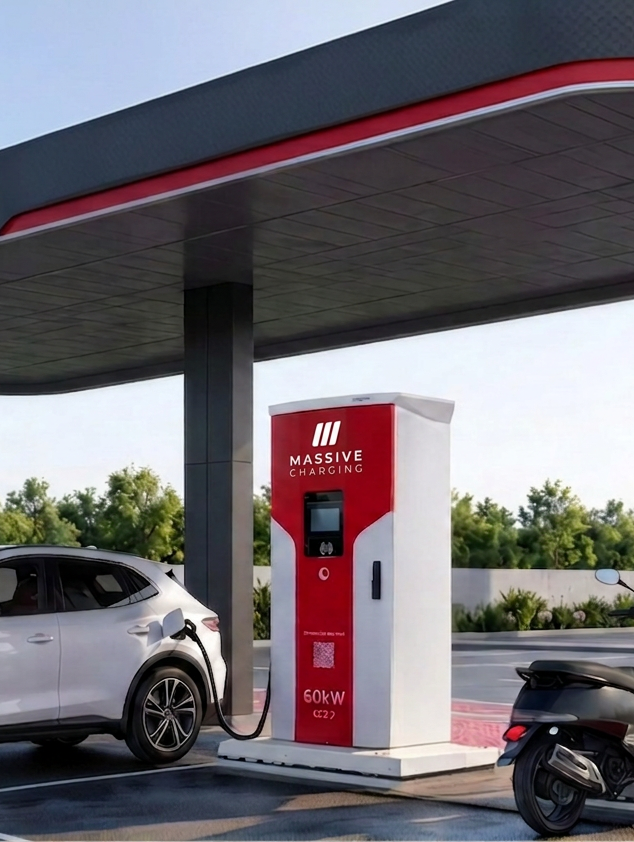
NewEnd-to-end EV charging setup — from power connection to payouts

Turn your parking space into an EV charging business

From selecting sanctioned DISCOM power loads to your own branded mobile app and automated UPI settlements, we answer every question standing between you and your first MWh sold.

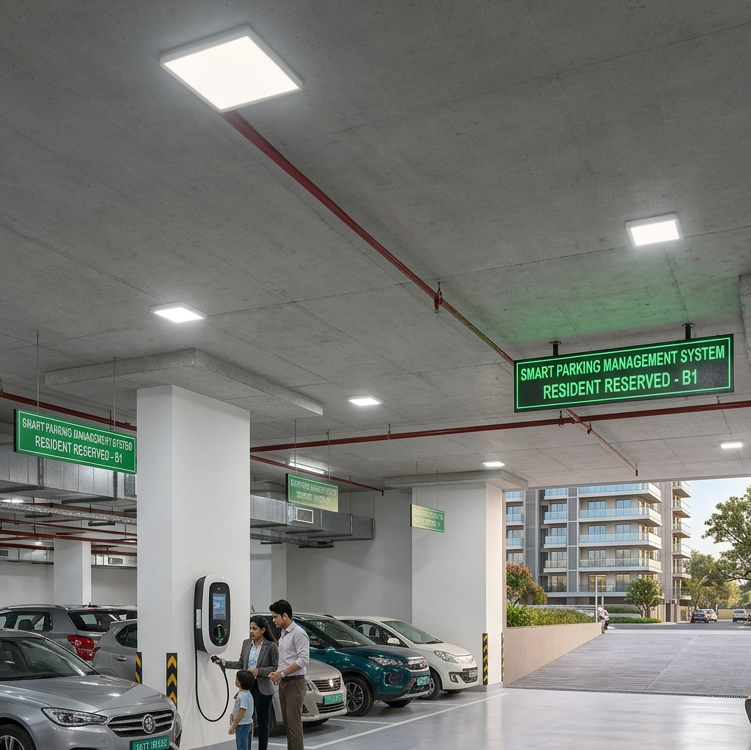
EV charger installed in a residential basement car park with a family charging their car

Meet Aman. Your journey starts here.

Owns 2,400 sq.ft prime commercial plot near Noida Expressway.

Aman

Commercial property owner

"I have idle commercial frontage with traffic. Can I build my own branded charging network instead of renting my space to another charging company?"

"Yes! Massive supplies turnkey hardware with custom vinyl wraps, your own iOS/Android driver app, and a live dashboard to manage pricing and payouts. You retain 100% station equity."

"What about grid clearances and who collects the UPI payment?"

"We handle the DISCOM connection and safety approvals for you, and funds land directly in your merchant bank account within T+1 days. Let's walk through your 5-stage roadmap below."

Your 5-Stage Roadmap to a Profitable Charging Network

Hardware, software, DISCOM clearances, and revenue models — everything between idle space and your first MWh sold.

  1. UnderstandAC vs DC, Protocols, Permissions01
  2. Hardware & SiteCCS2 Selection, High Dwell Siting02
  3. ClearancesDISCOM EV Tariff, CEI NOC03
  4. MonetisationUPI Gateways, Roaming, Pricing04
  5. Scale & RunCMS Telemetry, AMC, SLA Uptime05
Stage 01 · Understand

Core Fundamentals & Feasibility

Demystifying charging physics, regulatory approvals, and business viability.

At its core, EV charging is transferring electrical power from the grid into the car's battery. Grid power is always Alternating Current (AC), while vehicle batteries only accept Direct Current (DC).

AC Slow Charging (Destination): Delivers AC current directly to the car. The vehicle's built-in converter (onboard charger) turns it to DC. Because onboard converters are small (usually 3.3 kW to 11 kW), it takes 4 to 8 hours to fill.

DC Fast Charging (Transit Hubs): High-voltage conversion happens inside the external charger. It feeds DC straight into the battery pack via CCS2 or CHAdeMO connectors at 30 kW to 240 kW+, charging vehicles in 20–50 minutes.

Yes. You don't need an electricity licence. Under the Ministry of Power guidelines for EV charging, any property owner, entrepreneur or landlord can set up a public charging station.

Space Requirement: Minimum 1 to 2 standard parking bays (approx. 150–300 sq.ft) with unobstructed driveway ingress and egress.

Sanctioned Power Availability: Must have either an existing commercial meter with excess capacity or apply for a dedicated EV charging feeder.

Accessibility: Must provide open entry, standard fire safety provisions, and safe vehicle clearances.

Sessions run through a closed-loop automated software handshake compliant with international OCPP 1.6J / 2.0.1 standards:

1. Discovery: Driver finds your charger on Google Maps, Apple Maps, or your own branded app.

2. Plug & Authentication: Driver inserts the CCS2 connector. Authentication triggers by scanning the station QR, tapping an RFID fob, or via automated AutoCharge (MAC address recognition).

3. Digital Handshake: The charger verifies earth insulation resistance and battery voltage limits with the car's BMS.

4. Power Metering: Contactor locks shut; electricity flows. Real-time units (kWh), current, and temperature stream to your cloud CMS.

5. Payment & Invoicing: Session terminates; funds deduct automatically from the driver's UPI or digital wallet, issuing an instant GST invoice.

Stage 02 · Hardware & Site

Hardware Sizing & Location Selection

Matching the right kilowatts with dwell times to protect your capital expenditure.

Massive DC fast chargers at a highway charging hub

04 & 05How do I choose the location and the right capacity?

The single greatest pitfall for new operators is installing fast DC chargers where users park for 8 hours, or slow AC chargers on expressways where drivers will only wait 20 minutes. Capacity must mirror user dwell time:

Target LocationTypical DwellRecommended ChargerAvg. Charge Time
Residential & Workplaces6 – 9 Hours7.4 kW – 22 kW Dual AC5 – 7 Hours
Malls, Hotels, Multiplexes1.5 – 3 Hours30 kW – 60 kW Dual Gun DC45 – 75 Mins
Highways & Fleet Corridors20 – 40 Mins60 kW – 180 kW CCS2 DC Fast25 – 35 Mins
Heavy Trucking / E-Bus Depots30 – 60 Mins240 kW – 360 kW High Power DC30 Mins

Hardware Checklist

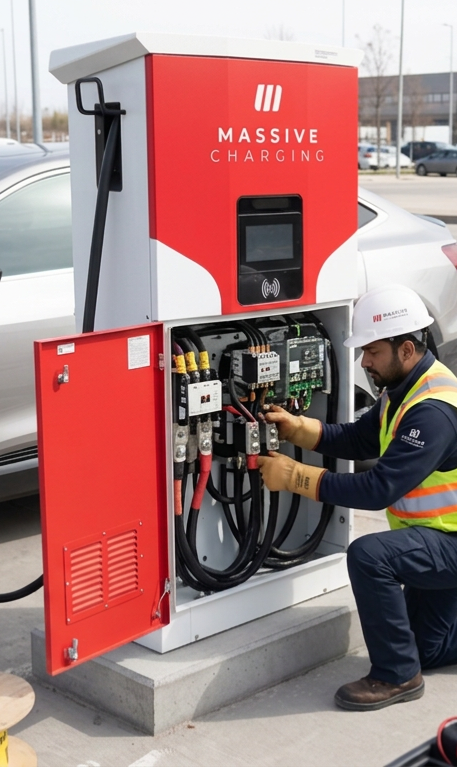
All Massive hardware is BIS certified and ARAI / ICAT tested.

IP55+

Protection: IP55 or higher for outdoor dust/monsoon resistance

55°C

Operating Range: Rated up to 55°C ambient heat

4G

Connectivity: 4G Dual-SIM with offline transaction caching

5m+

Cable Length: Minimum 5m flexible liquid-cooled or air-cooled cables

Stage 03 · Clearances

Power Approvals, Brand Identity & Safety

Connecting to state utility grids, establishing brand recognition, and mitigating risk.

Power tariffs make up over 60% of your ongoing variable operating cost. Applying under the dedicated EV category gets you a lower, dedicated EV tariff.

1. Load Requirement Calculation: Sum up connected loads (60 kW DC + 22 kW AC = 82 kW). Apply for an 85–90 kVA sanctioned load.

2. LT vs HT Lines: Up to roughly 50–100 kW (the limit varies by state and is usually set in kVA), DISCOMs allow a Low Tension (415 V LT) supply. Above that, you need an 11 kV High Tension (HT) supply with your own step-down compact substation (CSS) or transformer.

3. Online Application: Apply on your state DISCOM web portal (e.g., BSES, TPDDL, NPCL, PVVNL, UPPCL, DHBVN) under the "EV Charging Station" tariff head.

4. CEI Clearance: The Chief Electrical Inspectorate (CEI) inspects the earth pit bonding (below 2 Ω resistance), fire stop barriers, and residual current breakers before energisation.

Yes. Your brand on the charger and app. Massive runs the technology behind it, with end-to-end white-label deployments:

Custom Industrial Exterior: Hardware wrapped in your brand livery, Pantone colours, and backlit 3D acrylic logo.

Branded Consumer Apps (iOS & Android): Deployed under your developer accounts. Drivers see your brand name, wallet, loyalty points, and payment routes.

Central Management System (CMS): Access your master admin console to configure pricing, view utilisation heatmaps, and issue refunds.

Operating high-voltage electrical equipment in public parking areas requires a four-pillar insurance umbrella to shield against liabilities:

1. Commercial Public Liability (Third Party): Protects against claims for damage to a customer's vehicle while charging, or if someone trips over charging cables.

2. Machinery Breakdown (MBD): Protects your capital asset from power-module failure, voltage surges and inverter burnout.

3. Standard Fire & Special Perils (SFSP): Covers lightning strikes, flooding, earthquakes, and riot and strike damage.

4. Vandalism & Cable Theft: Insures high-value copper cables and connector holders against physical theft.

Stage 04 · Monetisation

Unit Economics, Pricing & Roaming

Structuring profit margins, automated payouts, and multiplying footfalls.

You keep the money. Payments flow through an integrated merchant payment gateway (UPI, cards, net banking and wallets) and settle directly into your current account on a T+1 cycle.

The Margin Math

Average DISCOM EV Power Cost₹7.50 / kWh

Retail Charging Tariff Billed to User₹19.00 / kWh

Platform & PG fee~₹1.50 / kWh

Your Net Spread₹10.00 / kWh

Indicative figures before GST; tariffs vary by state. 1 unit = 1 kWh.

Dynamic Time-of-Day (ToD) Pricing: Charge ₹16/unit between 11 AM–4 PM (tapping low solar tariffs) to attract taxi fleets, and ₹21/unit during peak evening hours (6 PM–10 PM).

Idle fee: Charge ₹3/min if the car stays plugged in 10 min after charging ends. This keeps bays open for incoming paying drivers.

Never rely solely on your own app to generate footfall. Through OCPI (Open Charge Point Interface) 2.2.1, your charging station is automatically broadcast across India's largest aggregator ecosystems:

Aggregator Interoperability: Drivers using other apps can discover your station, initiate charging, and pay seamlessly.

Global Map Discovery: Station pins on Google Maps, Apple Maps and Open Charge Map, with live availability where the platform supports it.

Fleet Dispatch Integrations: Commercial ride-hailing and e-commerce delivery fleets route their electric drivers to your chargers during idle afternoon windows.

Interactive Charging Revenue Simulator

Model your daily vehicle throughput and margin per kWh to estimate your monthly energy margin.

12 Cars
30 kWh
₹10.00 / kWh

Estimated Monthly Energy Margin

₹1,08,000

Sessions × kWh × margin × 30 days. Before rent, staff, maintenance, financing and other fixed costs.

Daily Units Sold

360 kWh

Est. Annual Margin

₹12.96 lakh

Stage 05 · Scale & Run

Live Tracking, AMC & SLA Diagnostics

Targeting 99%+ uptime through automated diagnostics and fast field support.

12 & 13What if my charger breaks down? (AMC & remote diagnostics)

Hardware downtime translates directly into revenue loss and frustrated drivers. Massive operates a two-tiered preventive maintenance network:

Level 1: Remote Auto-Heal (CMS): Most operational glitches (connector lock jams, protocol timeouts or gateway dropouts) can be fixed remotely in minutes with automated OCPP commands (soft/hard reset, connector unlock and over-the-air firmware updates).

Level 2: Field Engineering Bench: Critical hardware faults (power module failure, blown fuses, contactor thermal trips) dispatch automated tickets to local field technicians backed by a 24-to-48-hour SLA commitment.

Comprehensive AMC Packages: Includes half-yearly filter cleaning, terminal torque checks, insulation re-testing, and surge arrester replacements.

Telemetry Health Status (sample)

● CMS PulseOK (Ping: 42ms)

● Contactor Temp38.2°C (Optimal)

● Insulation> 50 MΩ (Safe)

● Last Reset14 days ago

Massive CMS flags abnormal temperatures before they cause a breakdown.
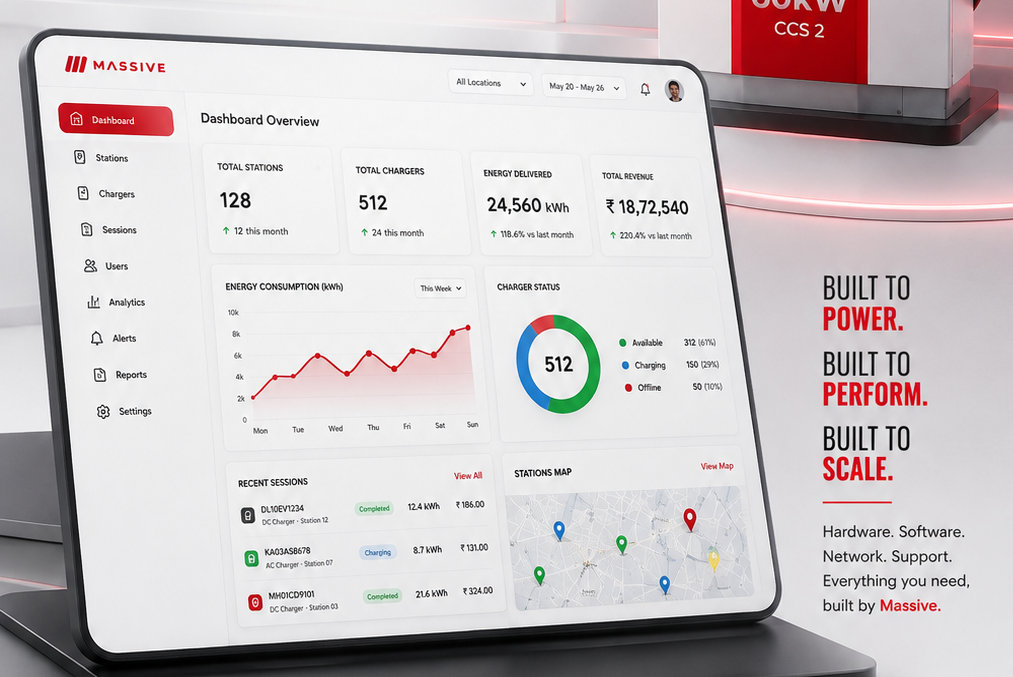
Massive CMS console showing live charger telemetry

14How do I track station usage & telemetry in real time?

As a station owner, you receive full visibility on your mobile device or desktop browser via the Massive CMS console:

Live Gun Telemetry: Observe actual charging speed (kW delivery curve), the vehicle's state of charge (SoC %) and session duration.

Financial Analytics: Daily, weekly, and monthly revenue breakdowns, average basket size per charging session, and GST tax liability summaries.

Driver Cohorts: Differentiate between repeat local commuters, transit travellers, and commercial fleet drivers to target customised loyalty promotions.

Station Owner Mobile App

• Instant push alerts for grid power outages

• One-touch remote emergency stop override

• Automated monthly statements generated in PDF & Excel

Total transparency. Manage 1 charger or 100 hubs from one screen.

Ready to start? Talk to an engineer.

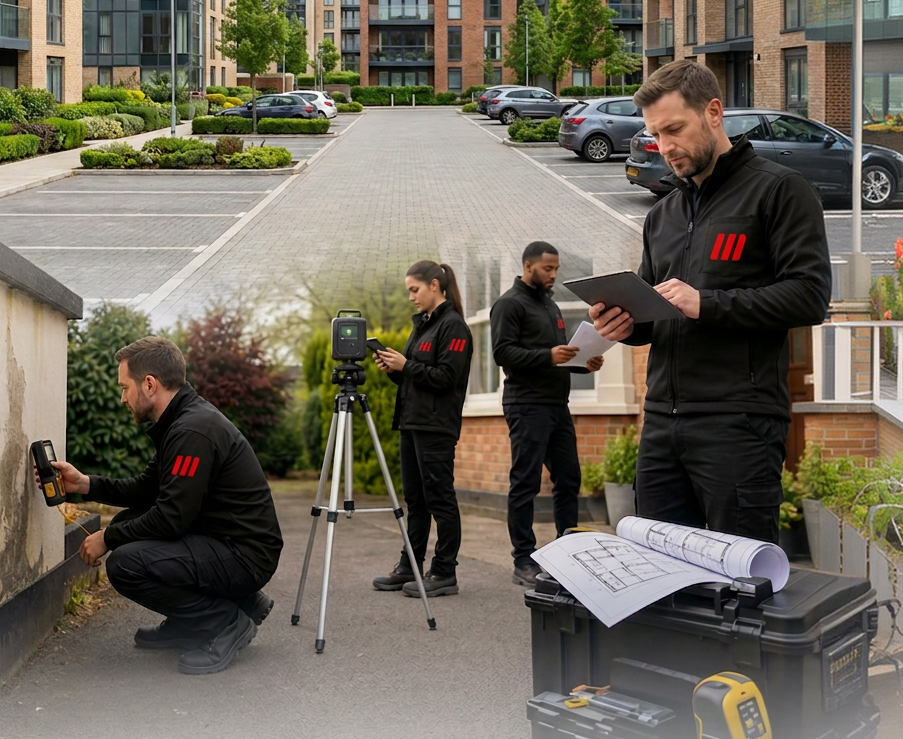
Whether you want to electrify a single commercial parking lot or roll out a multi-city high-speed charging corridor, Massive delivers the hardware, software, and execution. Start with a free site assessment.